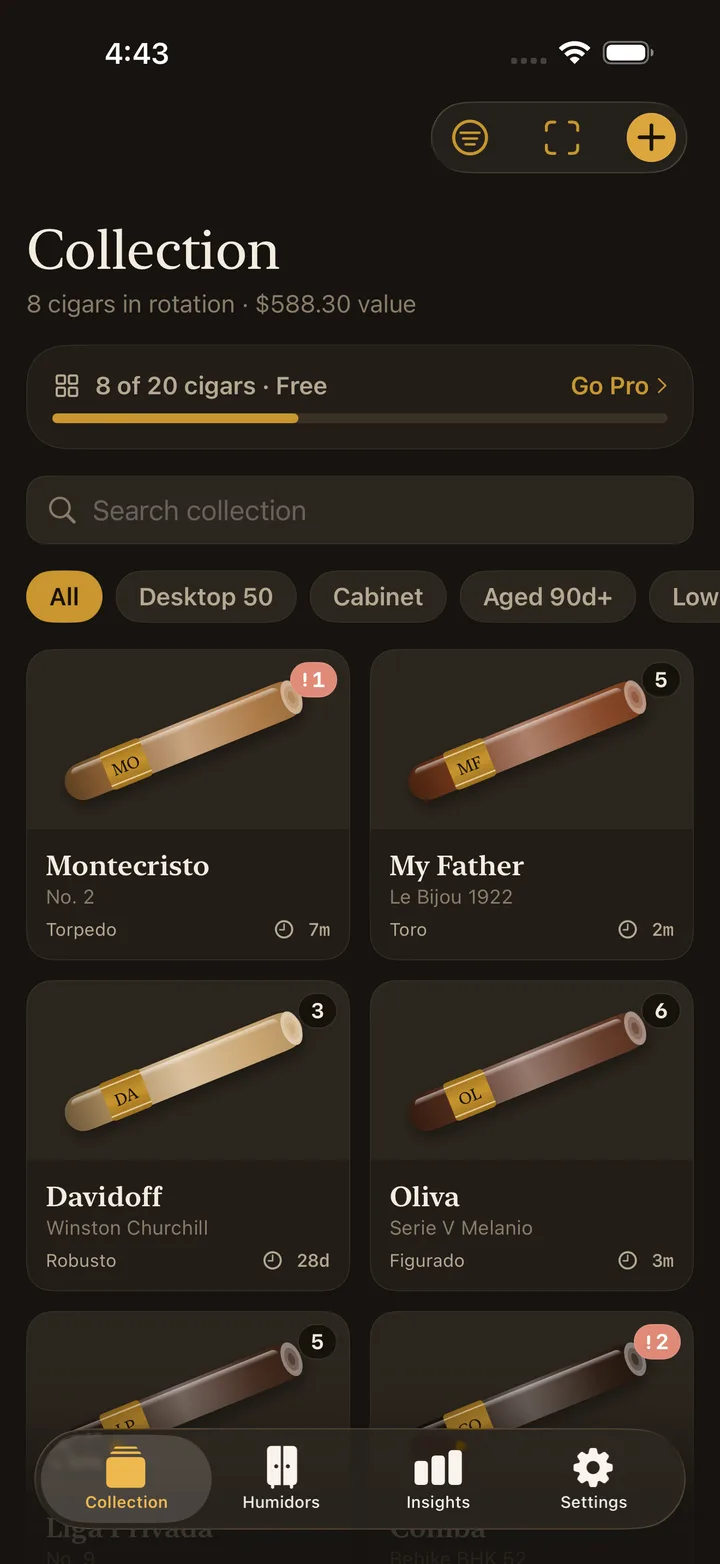
Why a list is not enough
Most collections start life in a note or a spreadsheet, and most of them stop being useful at about forty cigars. Not because the list gets long, but because a list only records what you have. It cannot tell you that the Padrón you bought in March is now past the point you wanted to start smoking it, or that you have quietly accumulated eleven robustos and no lanceros, or that the box you paid £180 for is worth rather more than the one beside it.
A cigar tracker earns its keep by recording the few extra facts that turn a list into a record you can question later: when each purchase arrived, what it cost, which humidor it sits in, and how the conditions in that humidor have behaved.
What Cedar tracks
Every cigar, once
Add a cigar with brand, line, vitola, wrapper, country and strength, plus a photo and your own notes. That entry is the identity of the blend — you add it once, no matter how many times you buy it again.
Every purchase as its own lot
This is the part a spreadsheet usually gets wrong. When you rebuy a cigar, Cedar records the purchase as a separate lot, with its own quantity, its own price, and its own aging clock running from the day it went in. A box bought last spring and one bought last week are tracked separately, because they are not the same thing — and when you smoke one, you know which.
Quantity that stays honest
Counts come down as stock leaves, per lot, so the number on screen is the number in the box. Cedar shows the running total across the collection and per humidor, and flags lots that are running low.
What it cost and what it is worth
Record what you actually paid per lot, and the MSRP if you want a comparison. Cedar totals both, so the value of the collection reflects your real outlay rather than a list price you never paid.
Storage conditions
Each humidor carries a target humidity and temperature range. Log readings over time and Cedar keeps the history, shows the trend and marks a humidor as in range, low or high at a glance. See humidor tracking for detail.
On iPhone, iPad and the web
The iOS app runs on iPhone and iPad from iOS 17, and syncs through your own private iCloud — nothing to configure beyond being signed in to iCloud, and no account to create. There is a separate web app if you prefer a keyboard and a large screen; it has its own free account.
Private, and portable
A catalogue of what you own is nobody else's business. On iPhone and iPad your records live on the device and in your own iCloud container — there is no Cedar server holding them, so there is nothing for us to see, sell or lose. There are no ads and no tracking across apps.
Export is free and lossless: a JSON file of the entire catalog that imports back on another device. You are never locked in.
What it does not do
Cedar does not sell cigars, link to retailers, or carry affiliate placements. There is no shop and no price comparison. It is a record-keeping tool for a collection you already own, for adults of legal age.